
Simple Physics With an Unforgiving Margin for Error
A loaded tractor-trailer can roll over on a dry, clear highway in the middle of a routine trip. The physics require only the right combination of speed, lateral force, and a load positioned too high or too far to one side. These are the conditions our I-294 semi towing crews respond to regularly, and understanding what creates them is where tractor-trailer rollover prevention starts.
It Starts With the Center of Gravity
A fully loaded tractor-trailer sits nothing like a passenger car. The cargo sits high, the wheelbase is long, and the trailer pivots independently from the cab. In a straight line, that geometry is stable. When lateral force enters the picture from a curve, a lane change, or crosswind, the mass above the axles begins pushing the trailer toward its tipping point.
The tipping point for a loaded semi is lower than most drivers expect. At highway speeds, a lateral acceleration of as little as 0.35g can initiate a rollover on a fully loaded trailer. That’s a moderately tight curve taken a few miles per hour too fast, not an emergency maneuver. The relationship between load height, speed, and lateral force leaves very little room for error.
When Freight Shifts, the Numbers Change
A load that’s properly blocked, braced, and centered keeps the trailer’s center of gravity as low and stable as the cargo allows. When freight shifts due to improper securement or settling during transport, the center of gravity rises and moves off the trailer’s centerline. An off-center load means one side of the trailer carries more mass than the other, and that asymmetry makes a lateral upset far more likely.
Even modest load imbalance compounds the risk on I-294 semi towing corridors where interchange geometry is tight. A trailer that handles predictably when loaded correctly can become unpredictable after a few hours on the road if the freight has shifted. Drivers who loaded at the start of a long run may not realize anything has changed until the trailer starts behaving differently in a curve or lane change.
The Inputs That Tip the Balance
Most rollovers on multi-lane highway corridors trace back to a handful of driver inputs:
- Taking a curve or ramp at a speed above the posted advisory
- Making an abrupt lane change to avoid an obstacle or close following gap
- Overcorrecting after drifting onto a rumble strip or shoulder
- Misjudging the arc of a merging lane and correcting late
- Applying the brakes suddenly at highway speed on a loaded trailer
These inputs aren’t always dramatic. A lane change that feels routine in a car can generate enough lateral force to upset a trailer with a high or shifted load. The cab can feel stable while the trailer has already crossed its recovery threshold. Gradual inputs, longer following distances, and conservative ramp speeds reduce the scenarios where that threshold gets tested, and keeping those habits consistent is what separates a routine run from an I-294 semi towing recovery call.
North Shore Towing: I-294 Semi Towing Built for Recovery
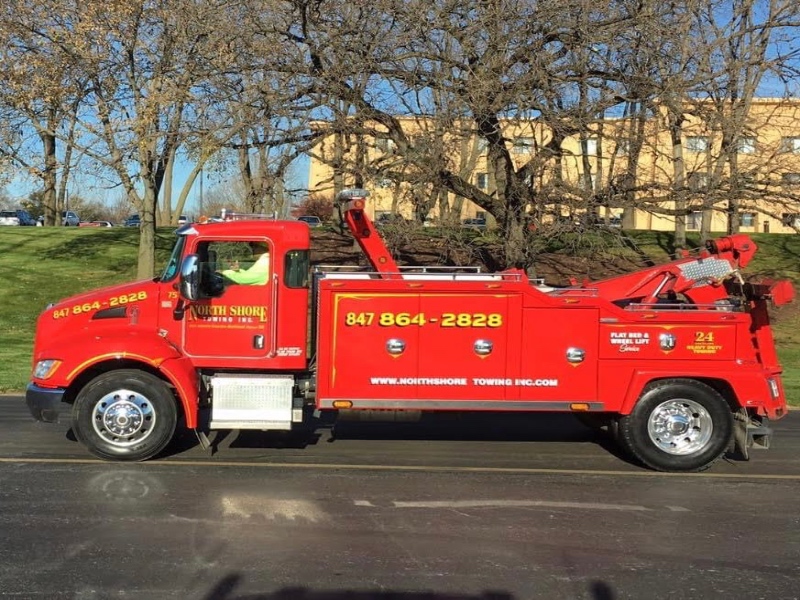
North Shore Towing handles I-294 semi towing recoveries from full rollovers to off-shoulder incidents. Our team knows the interchange geometry, the ramp grades, and the recovery setups this corridor demands. When a load goes down, our I-294 semi towing crew is equipped to respond, stabilize, and clear the scene as the job requires.
Every I-294 semi towing call we handle starts with a safe, organized approach to the scene. North Shore Towing carries the rotators, rigging, and heavy recovery equipment to work loaded trailer rollovers on this corridor, and we coordinate with state authorities when the scene calls for it. When the call comes in, we’re ready.
FAQ
What typically happens at the scene after a tractor-trailer rollover?
A rollover is treated as a major incident. State police secure the scene and manage traffic while heavy recovery specialists assess the load, the vehicle, and the safest method to right the trailer without secondary damage. Depending on the cargo, hazmat protocols may apply. The highway may be partially or fully closed for the duration of the recovery operation.
Are empty trailers more likely to roll over than loaded ones?
Yes, in some conditions. An empty trailer has less mass pressing down on the axles, which reduces the friction available to resist lateral tipping forces. It also rides higher than a loaded trailer, raising the center of gravity relative to available weight. Drivers hauling empty trailers sometimes carry too much speed through ramps because the trailer feels lighter, which can close the gap to rollover threshold faster than expected.
How long does it take to clear a semi rollover from a highway?
Recovery time depends on the load, the truck’s position, and the equipment required. A straightforward recovery with no cargo spill may take a few hours. Incidents involving spread cargo, damaged road surfaces, or limited access for heavy equipment can extend the closure significantly. Multi-agency coordination between state police, DOT crews, and recovery teams also adds time when each must work in sequence.
Can road conditions cause a rollover, or is it always driver input?
Road conditions are usually a contributing factor rather than a standalone cause. A driver who adjusts speed and steering for construction zone lane shifts, poor surfaces, or adverse weather keeps the lateral forces on the trailer within recoverable limits. When road conditions contribute to rollovers, it’s typically in combination with a driver input that crossed the threshold.
What federal rules govern cargo securement on commercial trailers?
The Federal Motor Carrier Safety Administration sets cargo securement standards under 49 CFR Part 393. These rules specify minimum tie-down requirements based on load weight, working load limits for securing devices, and specific requirements for cargo types including lumber, metal coils, and vehicles. Drivers are responsible for verifying securement before departure and at intervals during transport.
Does cargo type affect rollover risk?
Yes. Liquid loads in tankers create a sloshing effect during turns and braking that can shift the center of gravity rapidly. Dense cargo like metal coils or paper rolls sits high and requires precise centering. Loose bulk material can shift in ways the driver can’t detect from the cab. Each cargo type has specific securement and handling considerations that experienced operators account for before and during a run.